
The Ueno Bank case: what changes for landlords, tenants and buyers
Deposit guarantee, 40-minimum-wage advance, rent, deposits and aliases: what to do after the resolution of Ueno Bank, and the questions it raises.
By Hélène Montourcy, Founder of CALISTA ·
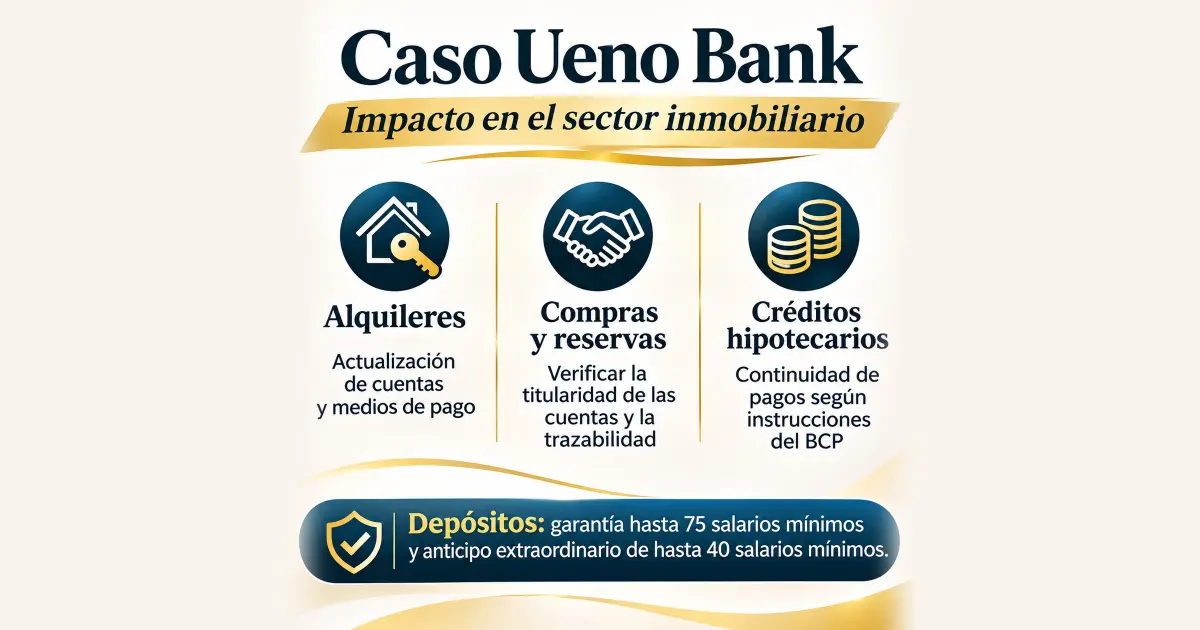
The resolution of Ueno Bank raises questions about the safety of bank deposits and has concrete consequences for property transactions. Here is what owners, tenants and buyers need to know.
On 2 November 2026, the Board of the Central Bank of Paraguay (BCP) unanimously decided to open resolution proceedings against Ueno Bank, as it officially announced the following day. According to the BCP, adjustments made to the bank’s financial statements during the regularisation process showed that its solvency ratio had fallen below 50% of the required minimum.
The situation affects many customers and has practical consequences for anyone who uses a bank in property transactions. Landlords who collect rent, tenants who pay by transfer, buyers who pay a seña (deposit) and developers who manage payments may need to reorganise their finances.
At CALISTA, we think it is important to explain what this means for the sector and which precautions to take.
1. What happens to deposits at Ueno Bank?
Paraguay’s financial system has a Deposit Guarantee Fund (FGD), governed by Law No. 2334/03, which protects depositors of institutions placed in resolution, within the limits set by law.
For Ueno Bank, the guarantee covers up to 75 monthly minimum wages, or G. 228,300,000 at the date of the resolution. This limit applies per depositor and per institution, not per account.
An exceptional advance of up to 40 minimum wages
On 4 November 2026, the Senate unanimously passed a law that extends Law No. 2334/03 and creates an advance on the deposit guarantee. The law was sent to the Executive. According to the Senate and the BCP announcement, its main terms are:
- Amount: up to 40 minimum wages per depositor, minus any overdue debts the depositor owes Ueno Bank.
- Timing: payment starts within 24 hours and may not take more than five business days.
- Where it is paid: if the depositor has accounts at other institutions, the advance goes to the account with the highest available balance. If not, a savings account is opened in their name at a bank or finance company.
- Notice: from 5 November, the BCP sends an email only from fgdpagos@bcp.gov.py stating which institution will make the payment. Be wary of any other message asking for personal data or passwords.
This advance is part of the guarantee: it does not raise the 75-minimum-wage limit.
For deposits above the guaranteed amount, recovery will depend on the applicable legal mechanisms and on how the resolution proceedings unfold.
Keep your bank statements and your receipts for deposits and transfers, and rely only on official BCP communications.
2. What should landlords who collect rent do?
If a landlord received rent in a Ueno Bank account, they should set up another way to collect it as soon as possible.
The change should be communicated to tenants in writing, with the new bank details and the name of the account holder.
If the lease names a specific account, it is advisable to record the change in an addendum signed by both parties.
Direct debits and scheduled transfers should also be checked.
These precautions prevent delays, payments sent to accounts that no longer work normally, and disputes over whether the lease has been honoured.
If you would rather not deal with this yourself, CALISTA collects the rent on the owner’s behalf, transfers it on the 10th of each month and sends a detailed statement of what was collected and paid. Learn about our rental management service.
3. What about tenants who paid from Ueno Bank?
A bank’s resolution does not cancel the obligations of a lease.
If a tenant can no longer use their usual account, they should contact the landlord or the managing agent as soon as possible to agree on another payment method.
It is a good idea to keep receipts for previous transfers and to keep a record of any difficulty affecting payment.
Quick, transparent communication between the parties avoids unnecessary conflict.
4. Deposits, reservations and off-plan purchases
Anyone who has paid a seña, made a reservation or paid instalments to buy a property should check who received the funds and how they are managed.
Paying into the seller’s account, a developer’s account or a trust (fideicomiso) is not the same thing. Each party’s rights and guarantees depend on the contract and on the applicable legal framework.
If a sale or a signing before the escribano (notary) involved a payment through Ueno Bank, the parties should agree on another payment method in advance and put it in writing.
For large amounts, checking the account holder and keeping a clear payment trail is an essential precaution.
5. What happens to loans?
The resolution of Ueno Bank does not cancel its customers’ debts, including mortgages where applicable. Loans are assets of the bank and may be transferred or managed under the legal procedure.
Before paying into a new account or institution, check the official instructions.
6. Bank aliases and continuity of payments
The BCP announced that aliases registered with Ueno Bank (ID number, RUC, phone number or email address) have been released in the instant payment system and can be linked to accounts at other institutions.
This makes it easier to reorganise regular payments. Landlords, tenants and managing agents should update their bank details and check which account and which holder an alias is linked to before sending a transfer.
7. A crisis that raises questions about banking supervision
The resolution of Ueno Bank also prompts reflection on supervision and risk prevention in the financial system.
According to the report the BCP sent to Congress, published by ABC Color:
- on 5 June 2026, the Superintendency of Banks asked Ueno to correct a breach of the limits on loans to related parties. The bank reported that it had done so on 15 June, within the legal deadline;
- part of that correction was made through a sale of a loan portfolio, which is the subject of ongoing administrative proceedings to determine whether there was indirect financing;
- on 24 July, the supervisor required other companies to be added to the bank’s group of related parties;
- a memorandum from the former head of supervision, sent on 10 July, was not referred to the BCP Board, which considered the issues were already being reviewed.
These facts alone do not show that resolution was inevitable in June. A supervisor needs to document its findings before acting. But the case raises questions of general interest:
- Why did five months pass between the first findings and the resolution?
- What preventive measures can be taken before a situation worsens?
- How is the confidence of depositors and the public in the financial system protected?
The answers lie with the competent authorities and with the ongoing administrative and judicial proceedings, in which the presumption of innocence applies.
For those of us who work in real estate, this episode is a reminder not to depend on a single financial institution and to manage funds prudently and transparently.
8. What lessons does this hold for the property sector?
A property transaction does not end when a contract is signed or a transfer is made. Funds must also be identifiable, managed and recoverable in line with each party’s obligations.
At CALISTA, we consider four precautions especially important:
- Spread your banking relationships. Keeping all your resources in one institution can cause serious problems when its services are interrupted.
- Manage third-party funds transparently. Money received or held on behalf of others must be identified and handled in line with the contracts and the law. This is the principle behind our rental management: every payment received, every expense and every commission is recorded, and the owner receives a statement each month.
- Check who holds the account and where the money goes. Before paying rent, a seña or a purchase price, check who receives the money and keep the receipts.
- Understand the terms of financial products. Beyond promotions, know when your funds are available and what protection the law provides.
Conclusion: trust also requires prudence
The resolution of Ueno Bank affects depositors, businesses and individuals, and raises questions about supervision and financial risk management.
Our aim is to help owners, tenants and buyers understand the practical consequences of this situation and take the necessary precautions.
Trust is essential in real estate, but it must go hand in hand with information, transparency and responsible handling of money. In a sector where each transaction may represent years of savings, protecting the security of payments and the rights of the parties is a fundamental responsibility.
Questions about your rent, your deposit or your purchase after the Ueno case? Message us on WhatsApp: we reply in English, Spanish, French and Portuguese. If you are an owner, you can also learn about our rental management service.
This article is for information only, based on information available on 5 November 2026, and does not constitute personalised legal or financial advice. Rules and payment procedures may change: always check the latest official communications.
Sources
- Central Bank of Paraguay, Banco Central inicia el procedimiento de resolución de ueno bank, 3 November 2026.
- Central Bank of Paraguay, Pago del anticipo de la garantía del Fondo de Garantía de Depósitos a los ahorristas de ueno bank S.A., 4 November 2026.
- Senate of Paraguay, Sancionan por unanimidad Ley que restituye dinero a ahorristas de Ueno Bank, 4 November 2026.
- Central Bank of Paraguay, Comunicado sobre uso de alias registrados en ueno bank S.A., 4 November 2026.
- ABC Color, Informe del BCP: estas son las 31 preguntas y respuestas, 8 October 2026.
General information: not a substitute for advice from a notary (escribano) or a lawyer.
Have a question about this topic?
Write to us: we reply personally, in English, Spanish, French or Portuguese.